
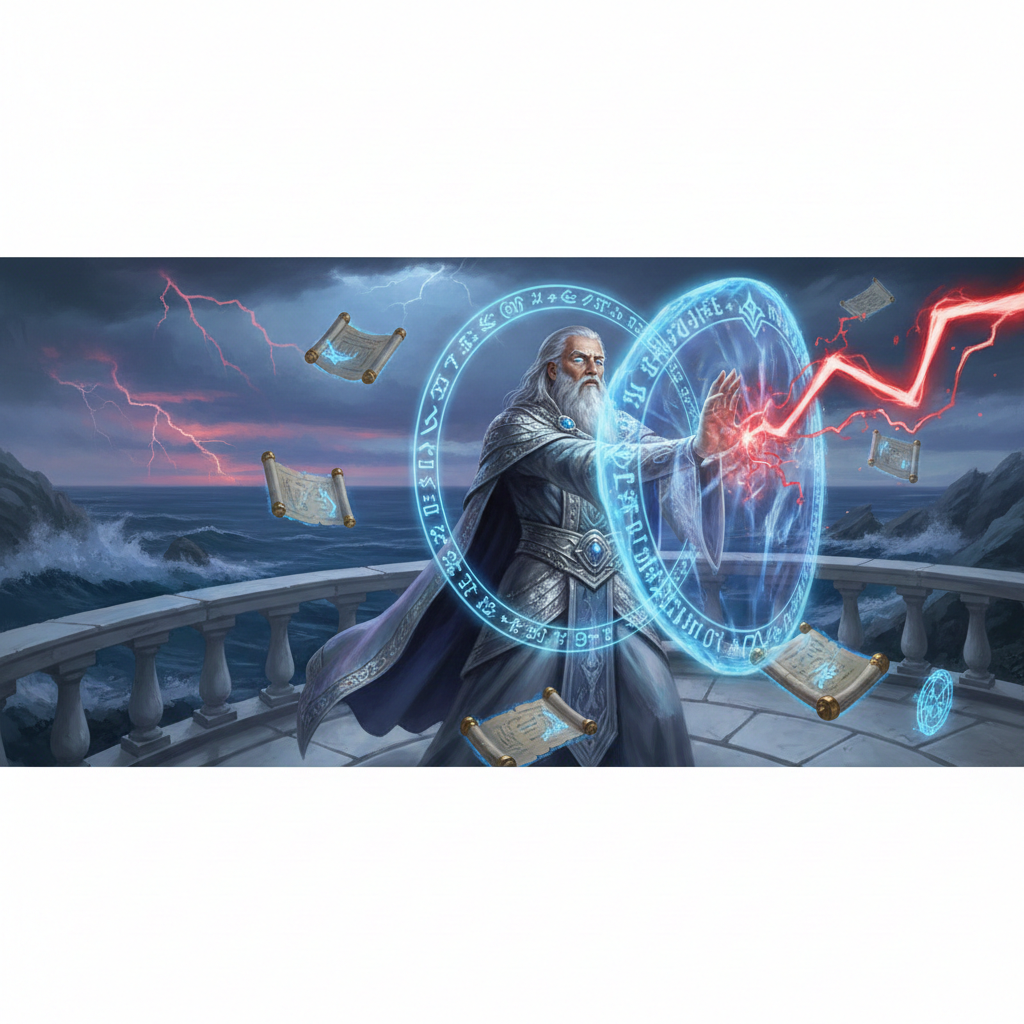
In Magic: The Gathering, every player wants to cast their big, game-ending spell. The Control player is the person who ensures that never happens.
Control players win twice: once on the board, and once in the opponent's head, three turns earlier, when they stopped casting spells for fear of the counterspell you weren't even holding. No archetype rewards experience more.
What is a Control Deck?
A Control deck is a reactive strategy. Unlike Aggro, which tries to win fast, Control tries to not lose for as long as possible.
The philosophy is simple: If your opponent cannot resolve their spells or keep creatures on the board, they cannot win. Eventually, they run out of cards and energy. At that precise moment, the Control player "turns the corner" and plays a single, overwhelming threat to end the game.
The Playstyle: Dictating the Flow
When you play Control, you are the "Gatekeeper" of the match. You aren't playing cards on your own turn very often; instead, you are sitting with mana open, watching your opponent.
Early Game
Spend mana to destroy or counter anything that looks dangerous. Your goal is simply to survive.
Mid Game
Use "Card Draw" spells to ensure you have more answers than they have threats.
Late Game
Establish "The Lock" - when you have so many resources that they can no longer meaningfully interact.
The Anatomy of a Control Deck
Balance four essential pillars. If any one is missing, the "machine" will break down.
Permission
Counterspells
The soul of Blue-based control. Counterspells stop a spell while it's still on the stack.
Save your counters for "must-answer" threats - cards that will win the game or stop you from drawing.
Spot Removal
Pointed Answers
You can't counter everything. Spot removal (usually White or Black) deals with a single permanent.
Cards like Go for the ThroatGo for the Throat or Get LostGet Lost trade one of your cards for one of theirs.
The Sweeper
Board Wipes
If an Aggro player plays four creatures, one Supreme Verdict destroys all - achieving a "4-for-1" trade.
This massive swing in card advantage is usually how Control decks stabilize.
The Finisher
Win Condition
Control decks run very few win conditions (2-3 cards). These must be incredibly hard to kill.
Modern favorites: Planeswalkers like Teferi, Hero of DominariaTeferi, Hero of Dominaria or un-counterable creatures like Hullbreaker HorrorHullbreaker Horror.
Associated Colors and Archetypes
While you can play "Control" in any color, some pairings are legendary for their efficiency.
Azorius (Blue/White)
Teferi, Hero of DominariaTeferi, Hero of Dominaria
The classic "Permission" deck. Uses the best counterspells and the best board wipes. The gold standard for pure Control.
Dimir (Blue/Black)
Notion ThiefNotion Thief
The "cruel" version. Uses discard spells to take threats from the opponent's hand before they can cast them, paired with efficient Black killing spells.
Jeskai (Blue/White/Red)
Narset, Enlightened MasterNarset, Enlightened Master
Adds "Burn" to the mix. Uses Red spells to kill small creatures early and finish off opponents, while maintaining counterspell backup.
Common Formats for Control
Standard & Pioneer
Control thrives in 2026 Standard. Lorwyn Eclipsed Faeries provide a flash-based control shell that plays entirely on the opponent's turn. Foundations reprinted essential counterspells and board wipes, giving Control players the deepest toolkit in recent memory.
Commander (EDH)
Control is much harder with three opponents - you can't counter every spell! Commander Control relies on "Stax" or "Pillow Fort" effects that make it annoying or expensive for people to attack you.
Three Tips for Beginner Control Mages
Master these fundamentals to dominate the late game.
Don't Be Trigger Happy
New players often counter the first spell. This is a mistake. Let small stuff through. Save your 'No' for cards that actually matter.
Lands Are Your Best Friend
Control decks need every land drop for the first 6-7 turns. Run 26-27 lands, not 20. Missing a land drop means you can't hold up a counterspell.
Play on the End Step
Say 'Pass' with mana open. If they play something scary, counter it. If not, cast a Draw spell at the end of their turn. Mana is never wasted.
The Land Count Secret
While an Aggro deck might run 20 lands, a Control deck should run 26 or 27. If you miss a land drop, you won't have enough mana to both play a card AND hold up a counterspell. Mana consistency is the foundation of Control.
Card images and card data courtesy of Scryfall. Magic: The Gathering is © Wizards of the Coast. ManaBuilder is unaffiliated with Wizards of the Coast.
Continue learning
Does Your Collection Have the Answers?
Control decks live and die on their ratios - answers to threats, counters to wipes, and lands to everything. Upload your collection and the builder will do the math: the most efficient removal you own, the right counterspell mix, and a finisher worth protecting.