
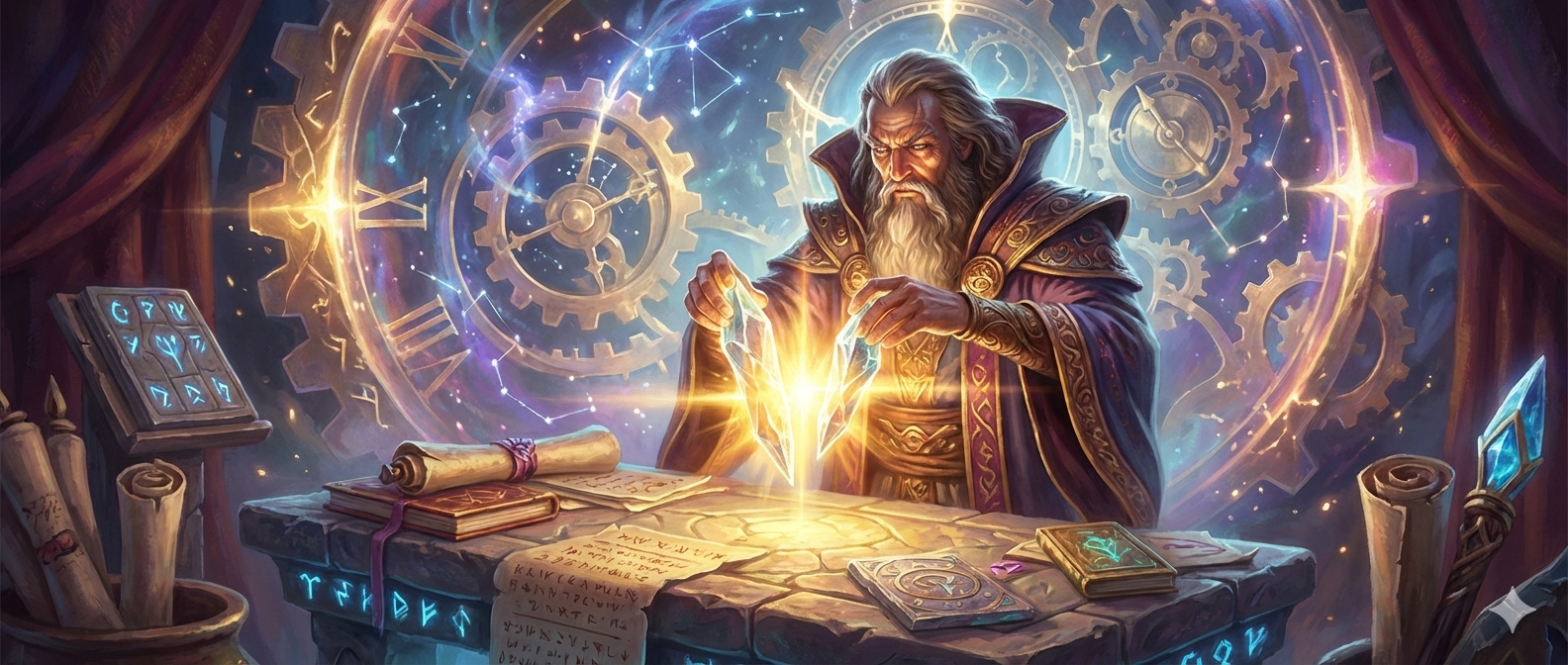
Most Magic games are won a few points of damage at a time. Combo players find that tedious. Why attack for two when the right pair of cards wins the game on the spot - no combat, no attrition, no permission asked?
This is the path of the Combo Deck.
If you've ever seen a player put two specific cards onto the table and say, "I win," you've witnessed a combo. For many, combo decks represent the ultimate expression of strategy in Magic. They turn the game into a high-stakes puzzle where your deck isn't just a pile of cards - it's a machine, and you are the engineer.
What is a Combo Deck?
In the simplest terms, a combo deck is built around a specific interaction between two or more cards that, when combined, create a game-ending effect.
The most common types of combos are "Infinite Loops." For example, if Card A allows you to untap a creature whenever you gain life, and Card B allows you to gain life whenever a creature untaps, you have created a loop that can be repeated a million times. If that loop also deals one damage to your opponent, the game is over instantly.
While "Aggro" decks focus on speed and "Control" decks focus on defense, Combo decks focus on the Assembly.
The Anatomy of a Combo: A + B = Win
Every combo deck is built around three distinct types of cards. To build or play one successfully, you must understand how these categories work together.
The Combo Pieces (The Engine)
These are the specific cards that create the winning interaction. Most beginner-friendly combos are "Two-Card Combos." As you get more advanced, you might find "Three-Card" or even "Four-Card" combos, though these are much harder to pull off in a real game.
Example: Sanguine BondSanguine Bond (opponent loses life when you gain life) and Exquisite BloodExquisite Blood (you gain life when an opponent loses life). Together, they trigger each other until the opponent hits zero.
Tutors and Filtering (The Search Party)
You can't win if your combo pieces are at the bottom of your deck. Combo decks rely heavily on cards that help you find your pieces. Tutors let you search your entire library for a specific card. Cantrips like Opt or Ponder let you dig for your engine quickly.
Protection (The Shield)
Experienced players will try to stop your combo. They might use a "Counterspell" or a "Removal spell" the moment you try to win. Combo decks must run protection - cards that stop your opponent from interfering with your puzzle while you are solving it.
Example: NegateNegate to stop their removal, or SilenceSilence to prevent them from casting spells during your turn.
The Combo Playstyle: High Stakes and Strategy
Playing a combo deck feels very different from playing a standard "creature-heavy" deck. Here is what you can expect:
The "Glass Cannon" Approach
Some combo decks are built to win as fast as possible (Turn 1, 2, or 3). These are called "Glass Cannons." They are incredibly fast and powerful, but if the opponent manages to break a single piece of the combo, the deck often has no "Plan B" and will lose immediately.
The "Control Combo" Approach
Other decks play a long, defensive game. They use removal and blockers to stay alive for ten turns, slowly gathering their pieces and waiting for the perfect moment when the opponent is "tapped out" (has no mana left to respond) to strike.
The Eureka Moment
The appeal of combo is the "Eureka!" moment. It's the satisfaction of seeing a complex interaction through the fog of war and executing it perfectly. It rewards players who have a deep knowledge of the rules and how different card mechanics "stack" on top of one another.
Popular Formats for Combo Players
Different formats offer different opportunities for combo strategies.
Commander (EDH)
Commander is the most popular place for combo players today. Because you have 100 cards and 40 life, games last a long time, giving you plenty of space to find complex, high-mana combos. However, be aware of "Social Contracts" - some casual groups prefer games without infinite loops, so always check with your friends first!
Modern and Pioneer
These are competitive formats where combos are often the "benchmark." Lorwyn Eclipsed has introduced new tribal-combo synergies (Changeling loops, Faerie flash chains), while Foundations reprints have made classic combo protection spells more accessible. Famous combos like Splinter TwinSplinter Twin (now banned) or Amalia Benavides AguirreAmalia Benavides Aguirre have defined these formats for years.
Kitchen Table (Casual)
If you are building from a random collection of cards, look for "Synergy Loops." You might not have a world-class infinite combo, but you might find two cards that work so well together they feel like a combo.
When Should You Choose a Combo Strategy?
You should build a combo deck if:
- You love puzzles: You enjoy the mathematical side of the game.
- You prefer "Big" wins: You'd rather win all at once than slowly attack with small creatures.
- You have a specific "Engine": You looked at your collection and found two cards that seem to "break" each other.
Managing the "Salt" Factor
A quick tip for new players: Combo decks can sometimes frustrate opponents because they can feel "non-interactive." If you win on turn 3 before your friend even plays a creature, they might not have much fun.
The Fix: Use your combo deck as your "Power Deck" for competitive games, but keep a Tribal or Value deck ready for more casual, social sessions.
Card images and card data courtesy of Scryfall. Magic: The Gathering is © Wizards of the Coast. ManaBuilder is unaffiliated with Wizards of the Coast.